Pages

Showing posts with label facebook. Show all posts

Monday, 27 April 2015

Groupon's EPIC social media usage

This is going to be a ridiculously quick one as I am absolutely drowning in revision for my Marketing Services exam on Wednesday...however after a little lot of procrastination, I came across this absolutely brilliant use of social media from Groupon, and I couldn't not share it!

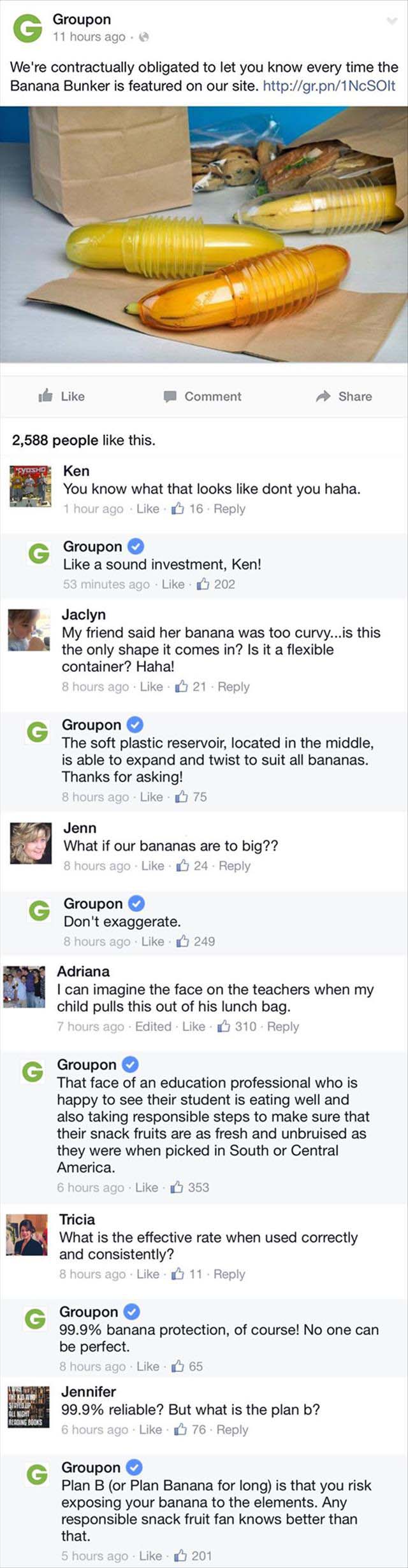
Have a read through this post on Groupon's Facebook page- and their fantastic responses to comments!

Groupon had posted the product on social networks previously and had received endless comments regarding the products similarity to something else... and Groupon decided to act on these responses in the best way possible- by embracing them!
The comments went viral and in turn gave Groupon fantastic PR and showed a lighter side to the brand. This reminds me slightly of the Penguin's #YourMum campaign I posted last month, however I believe Groupon did a much better job of embracing comments which were designed to 'take the piss' in a tactful, funny and witty manner.
Apparently, Groupon assigned three social media employees out of five to respond to comments on the Banana Bunker thread- real commitment!! The posts brought the spotlight to Groupon's page and they sold all of the Banana Bunkers before the post started being shared online! What a great way to sell inventories without doing a boring sales promotion!

When marketers think outside the box, react to trends (especially online), interact with consumers and deliver humour specific to their own product- it clearly pays off! Whether than be with short-term, fast sales or when building long-term relationships!

More posts once my exams are done!

Wish me luck,

Stephanie


Sunday, 25 January 2015

Why creating DEMAND from consumers is the best marketing tool!

I don't know about you but everywhere I've driven, every TV show I've watched and every social media channel I've browsed in the last couple of weeks, I can't help but noticed McDonald's new marketing campaign, whether it be in outdoor advertising, TV and radio ads or paid posts across Facebook and Twitter;


Yes, the McRib is back! Now, I can't say I'm a regular McDonalds visitor myself, but judging the hype on social media, this was a clearly loved product. The McRib product is often introduced for limited periods of time and then taken off the menu. Clearly the marketing spend around bringing the McRib back has been huge as I have seen it just about everywhere! By creating these touchpoints, consumers can build their excitement and remember the product everywhere they go.

Now, one may argue why do McDonalds created this 'limited-time-only' product? If it's so popular- why don't they just keep it on the menu year-round? 

Well, from what I can tell, when it was on the menu permanently, the sales were low... yet not low enough to keep it off forever... so here are the reasons I believe that the intermittent reintroduction of McRib is a great marketing strategy;

  1. It creates a sense of urgency in the consumer: It's available for a limited time only! The consumer must stock up if they want to make the most of the product whilst it's still around. The great thing about food is that it's perishable... so customers can go back to McDonalds as many times as possible in the time period in order to repurchase.
  2. Nostalgia: Customers may remember the product from the past and want to relive perceived 'happier times'... this also applies to brands who have executed this brilliantly e.g. Cadbury's Wispa
  3. Retains customers who may not be regular customers: Customers who might not regularly make trips to McDonalds may do so purely to purchase the McGrill- this therefore brings in extra custom and the potential to retain them further/ up or cross-sell.
  4. Creates a great talking point: We all know social mentions and shares are fundamental to establishing an online presence, therefore something which consumers feel their peers may talk about/ something which they perceive to be 'safe' to discuss like McDonalds food.... is likely to be highly discussed. This also applies to the offline world.
  5. Something new, but not a risk: New products can hit it off with consumers, but their sales are usually low to begin with due to consumers fearing trying something new. However, the fact that McDonalds have brought this back because it was so well loved in the past, which is a message highly reiterated in their marketing communications activity for McGrill, consumers are much more likely to buy it. When your peers like something- you are likely to want to like it too!
  6. Customers feel like they have achieved something: By creating a 'hype' or an upstorm about bringing the product back, customers feel like they have caused this and therefore they feel a better connection with the brand as they feel as though their needs are being listened to. Effectively, this is the case, but it also brings more awareness and talk around the brand itself
This is the kind of genius marketing I get excited about!! So simple yet so effective!

Stephanie

Thursday, 8 May 2014

Opt-in, Opt-out

Digital marketing, arguably, and especially in the B2C world- is one of the most effective methods of reaching your target audience. However, as more and more organisations jump on the digital bandwagon, the quantity of marketing noise from more and more brands which consumers are faced with has rapidly increased.

Take Facebook- personal profiles were hugely successful and once Facebook allowed brands to join the site and create corporate/ brand pages, they started popping up all over the place. From the biggest brands such as Cadburys, Starbucks and Tesco to the local pub, butchers and community centre all creating engaging content through online social media sources, utilising websites and sending out emails- they are all at it and I know my social media pages have started to become much less social and much more brand-focused!

With this ever looming presence that consumers feel they are being sold to, constantly marketed towards and annoyed by persistent messages- is email marketing still useful when reaching a consumer? Or will it go straight into the 'Junk' or 'Deleted' folder?

Usually when signing up to newsletters, entering competitions or buying products online, you usually have the choice of opting-in or opt-out of receiving emails from the brand. This allows the consumer to have full control over the marketing messages they receive.

This infographic from Marketing Week indicates how willing consumers are to sharing their data (such as email address, phone number or postal address) with companies for the purpose of marketing. It's really useful to understand how willing people are to let companies market/sell to them. The impression I have gathered from working in a B2B scenario is that people are far less likely to 'opt in' to receiving marketing messages unless:

a) they are being provided with something of value, whether that be content, information and help or a personalised message
b) there is an incentive to do so- discounts, a competition or another type of reward
c) it is a company they really trust, admire or like- this can make it harder for start-ups or less-established brands trying to reach new markets to utilise database marketing

Think about how much you click the unsubscribe button on the endless email messages you receive from brands, or how many times you 'Unlike' an organisation's Facebook page?

I believe the key to maintaining a consumer's interest in your marketing messages, whether that be email messages, social media posts or even post (who does direct mail any more seriously?!) is down to 3 things:

a) Consistency: you have to absolutely nail this one; don't post too much and don't post to infrequently. This is mainly down to experimentation of how the interaction with your posts differs depending on the frequency of them, for email this is click throughs, for social it could be shares, likes or comments etc.
b) Content: provide something of value or that email is going straight into the delete folder, or that post is getting hidden! Whether that be discount, free delivery for e-commerce, coupons or vouchers for in-store purchases, competitions, product launches or events.
c) Personalisation: this potentially may be the most important point in marketing messages- whether you are targeting a new customer, loyal customer or someone who hasn't made a purchase in a while, the marketing messages must be tailored, even if you offer them the same incentive! Make the customer feel as though they are unique, valued and not just another name on a spreadsheet and I believe you will nail email marketing!

Stephanie

Thursday, 20 March 2014

Cancer Research: No make up selfies are genius for non-profit marketing!

How could I, as a marketing blogger, not mention the massive trend this week- No make-up selfies to raise awareness for breast cancer!?!

As I am sure you are all aware- through facebook and twitter, EVERYONE seems to be taking make-up free photos of themselves and uploading them. Cancer Research have suggested that since the trend started they have received a huge increase in the levels of donations to the charity that they have been receiving, enough to even crash their donation systems!

However, CRUK have also said that they have no idea where the idea came from yet clearly they support it!

I know on my Facebook there was a lot of controversy, especially from those saying it is a pointless trend, that taking photos of your face make-up free isn't going to cure cancer and other like-minded comments. These negative comments and retaliations from those arguing the other side of the case have actually given the cause an even stronger presence online!

This is just another fantastic example of how social-media can be used to drive awareness and in the non-profit marketing world, donations...

However, the thing that is unique about this example of social media marketing is that it wasn't driven by the brand it was driven by the consumer! I feel as though a marketing trend could be emerging which brands need to think very carefully about how then can use to the best of their ability!

Cancer Research were very lucky to be at the center of this- lets hope we see more consumer-driven marketing examples in the future!

Steph 

Wednesday, 18 December 2013

Brands who got it RIGHT: Oreo

A brand who have always done their social media marketing exceptionally well is Oreo! They have been referred to a "social media innovators" and have received exceptional recognition for the social media marketing they have demonstrated.

This post is on why I think they are social media masters:

I mentioned them in the newsjacking post previously, but there are hundreds of more examples of excellent use of social media by Oreo.

Check out these vines that they produced:


The thing that makes these so entertaining is the creativity and the success that Oreo create is SHAREABLE.

There is no point creating a loyal fan base or even posting social media content which has no shareability value- make content which people want to tweet or revine or tell their friends about!

Oreo connect with their audience, they have a strong following amongst their social media platforms and they engage with their target audience CONSTANTLY.

What some brands tend to do is run social media campaigns which publish heavy content and responses around a particular product release or around a particular time of year and then remain fairly quiet until the next one. However, Oreo continually updates with relevant, current and consistent content.

They respond to news stories, important dates, trends and peaks- this means users react in real time and are willing to interact with the Oreo brand. Look above at the phone case tweet- Oreo uses wit and humour to engage their audience and inspire others to share more!


Reasons why Oreo wins best use of social media marketing:
HUMOUR, CREATIVITY, CONSISTENCY, SHAREABILITY

an inspiration and a case study for all brands to learn from- Congrats Oreo!!

Thoughts and opinions all my own.
Stephanie Clark

Tuesday, 10 December 2013

Brands who did it BADLY

I'm often talking about brands who use their social media channels and advertising well, but 'they' say "by seeking and blundering we learn.” and in the marketing world, we can also learn from others mistakes... 

and I guess they are more interesting to read to!

So here we go.... Marketing Flops!

1.

Firstly, a US brand, SpaghettiOs posted this tweet in commemoration of the anniversary of Pearl Harbour:
This was followed by many angry tweets;


The tweet was deleted and replaced with an apology.

 Well followed up considering the consumer response. However- what can we learn from SpaghettiOs mistake?

Never make it about yourself- a quote from Mack Collier "You don't ask others to remember a military tragedy by putting the focus on your brand mascot. NEVER make it about you."

The fact is- in order to bring brand value, make the tweets personal  and empathise  with people, make your tweets seem human!!

2.

In the US, the supermarket Kmart tweeted to reveal they would be open on this Thanksgiving and would stay open on Black Friday. Customers complained about the ethics of the decision by the masses: 


What can we learn from Kmart's mistake?

a) Marketing isn't just about the communications you portray and publish i.e. advertising, direct marketing etc. it is also about Corporate Social Responsibility and how you treat your staff is a big part of this- as is fair competition. By opening on Thanksgiving- Kmart were demonstrating their lack of ethical standards for both, this was clearly pointed out by their customers. By publicising this fact, Kmart allowed themselves to be exposed to a storm of dismay.
b) Don't post the same response to every tweet!!! Re my above comment on SpaghettiOs make your tweets personal! If customers have an issue or complaint they want to feel valued and understood, not dumped in the pile with everyone else and given a phony excuse!

3.

So far we have seen American brands failing on social media, but here's a British brand who make it in to the ranks! This one comes from Facebook on Luton Airport's page:

The message behind it could have been enforced in so many better ways! The pictured they posted was from a plane crash in 2005 in which there were fatalities which included a 6-year-old boy.

Way to show your insensitive side?? I don't think this example needs much explanation as 'what not to do'...

4.

This little gem from Red Robin....


As a vegetarian I can't say I am highly offended by this advert, however I can imagine how, especially in the US Culture, some people would be. The fact that Red Robin suggests that "vegetarians are just going through a phase" is poking fun at peoples' beliefs and I believe as a brand anything which ANYONE could find offensive should be avoided!

What can we learn from Red Robin's mistakes?
a) Understand the culture of your target audience and make sure you respect, inhabit and encompass it into your consistent branding themes. Make their culture, your culture....
b) I feel like Red Robin could have completely turned this around with a good recovery strategy and clever PR. When you make a muck-up- recover, recover, recover. They could have offered vegetarians a free burger, introduced new vegetarian options or even created a new ad campaign to turn this one on it's head! However, the disaster recovery wasn't effective and the video and it's angry responses went viral....

Check out these video responses on YouTube:

5.

Just read this article on Food Beast: 14 Ways To Ruin Your Restaurant Business and Lose Friends

Uh oh..... major fail! Be careful about your own publicity!! Pretty sure thats the No1 Rule of Marketing....


Let me know if you enjoyed this post! I may do more like it!!
All opinions are my own!

Stephanie

Tuesday, 6 August 2013

Dispatches: social media fooling and celebrity endorsements

Hello,

So last night i watched dispatches on channel 4 which often highlights unlawful/unethical treatment whether that be of consumers, staff, general public or animals. The programme is always worth a watch but last night was particularly interesting, especially if you have an interest in marketing/advertising or celebrities. The show was titled 'celebs, brands and fake fans' and explained how companies can sometimes hype their own products by paying for Facebook likes, twitter followers or YouTube hits. This false popularity can often lead consumers to purchase products they believe are popular when as a matter of fact this following has been created by an IT hacker in Bangladesh.

The programme also had a focus on celebrity endorsements on twitter and that celebs have been promoting products without revealing to fans they have been paid to do so and breaking the asa code. The sad reality is that whilst these marketing agencies or departments have been putting all the best efforts to create a buzz around their products has actually back fired with the revelations on the show. The only way to create a natural, genuine hype or buzz about a product is to sell a product which is of good quality, provide a good service or to create something interesting and then word of mouth will be your best friend! Companies should have learnt by now that consumers DON'T LIKE BEING LIED TO!!

However I do believe that giving products to celebrities free gifts and asking them to review or recommend them is an excellent form of marketing and isn't unethical if the celebs actually give their own opinion of their own free will.

A lot of companies have started to use this method not only with celebrities but with bloggers- a lot of which I read. Recently I was reading a fashion blog which recommended the website sheinside.com and featured some clothing items off there which the blogger loved..... Paid? I don't know...

So I decided to go ahead and buy the top as it did look lovely on the blog. My top arrived about a month later.... And it was faulty! When I tried to contact the website I realised they are based in china and provide terrible customer service and most of the responses to my numerous emails have been worded in terrible English! Not good and now I am let with faulty clothes and no refund! 

My point is, bloggers and other endorsers may recommend products even when they aren't great! Do t trust everything you read.

And you will be happy to know everything in my blog is my own opinion!!
Steph

Thursday, 18 April 2013

Ethics

Personalised advertising online can be an excellent tool for advertisers; a. to reach their target audience directly b. not to waste money advertising to the wrong consumers and c. to measure the effectiveness of the adverts by monitoring clicks.

However, adding to my previous blog post on the use of cookies, there are much stronger ethical concerns which I have noticed recently (mainly from Yahoo and Facebook).

So when I was booking flights to Malaga recently, I was clearly searching for a good deal and using Google searches to do so. I clicked on to various 'money saving' comparison sites. Then once I had booked the flights, for the next 2 weeks I was bombarded with adverts such as "hotels in Malaga" "car rental in the Costa del Sol" etc.
Clearly this is effective advertising and the companies behind the adverts are reaching their target audience (i.e. me).

On the other hand, I was also searching to buy a juice diet book and some raspberry ketones (big slimming movement before Costa del Sol....) and was again using google, amazon etc to search for these and checking out celebrity body results from using the diet regimes.
Now everytime I click on to my facebook timeline or on the side of a website I see photos of skinny celebrities, flat stomached women and 'quick-fix' diet plans.
This is driving me mad as it's making my self-image = 0 and my motivation to get thin = 100. I am quite a receptive person but also have a level of self-control HOWEVER surely someone suffering from an eating disorder making the same kind of searches as me, or more specific weight loss searches would also be bombarded with the same types of advertising (considering their cookies settings were similar etc.) but imagine the effect this would have on them!?

Showing skinny celebrities is one ethical consideration however displaying them to an unconfident, potentially vulnerable target audience is an entirely different ethical consideration!
I think companies should consider the effect it has on their stakeholders- particularly the vunerable ones.

The media can't be blamed for everything.

Friday, 18 January 2013

Public Relations disaster and success

So the big news this week was the Tesco story that horsemeat has been found in their burgers! I'm a vegetarian so this doesn't really affect me THANK GOD but I was really interested to see how Tesco's public relations department handled the crisis. Frankly, it's good news for sainsbury's, asda and morrisons who are now making claims such as 100% British beef and can use their farming as an advantage over the market dominator. Tesco deserves such revelation after cutting corners in order to stay on top.

I noticed how the Tesco twitter and facebook pages hadn't released a statement even 24 hours after the news had been released even though Tesco had been trending on twitter for hours. Eventually they did release a statement which I felt was to a certain degree reassuring however I feel the twitter page could have been used to better effect whilst the scandal was occurring, there was no posts even declaring that a statement was going to be released later on and I think that whilst Tesco's shoppers where questioning their loyalty to the company, Tesco could have been a reassuring force whilst monitoring their social media.

However last night Tesco posted this tweet:
<blockquote class="twitter-tweet"><p>It's sleepy time so we're off to hit the hay! See you at 8am for more <a href="https://twitter.com/search/%23TescoTweets">#TescoTweets</a></p>&mdash; Tesco Customer Care (@UKTesco) <a href="https://twitter.com/UKTesco/status/292043677897994240" data-datetime="2013-01-17T23:00:13+00:00">January 17, 2013</a></blockquote>
<script async src="//platform.twitter.com/widgets.js" charset="utf-8"></script>
I think the humour works well on a tweet that could have backfired and it's British "laughing at ourselves" humour and gave Tesco a moment on twitter as it has thousands of retweets, rather than entirely negative publicity.

However the daily mail doesn't seem to think so: http://www.dailymail.co.uk/news/article-2264394/Horse-meat-scandal-hit-Tesco-centre-Twitter-backlash-customer-care-message-told-followers-staff-hit-hay.html#ixzz2IK0VApdY interesting article!!

So in my opinion Tesco did a half hearted job and need to improve their crisis management for the future, but hit back well.

A company that handled social media crisis management extremely well were Bodyform, this happened a while back and I was going to blog about it when I heard about it but now I think is a perfect time to;

In response to the bodyform adverts this was posted on the bodyform facebook page:

 
Hi , as a man I must ask why you have lied to us for all these years . As a child I watched your advertisements with interest as to how at this wonderful time of the month that the female gets to enjoy so many things ,I felt a little jealous. I mean bike riding , rollercoasters, dancing, parachuting, why couldn't I get to enjoy this time of joy and 'blue water' and wings !! Dam my penis!! Then I... got a girlfriend, was so happy and couldn't wait for this joyous adventurous time of the month to happen .....you lied !! There was no joy , no extreme sports , no blue water spilling over wings and no rocking soundtrack oh no no no. Instead I had to fight against every male urge I had to resist screaming wooaaahhhhh bodddyyyyyyfooorrrmmm bodyformed for youuuuuuu as my lady changed from the loving , gentle, normal skin coloured lady to the little girl from the exorcist with added venom and extra 360 degree head spin. Thanks for setting me up for a fall bodyform , you crafty bugger
 
The post recieved over 100,000 likes and despite his humour and attempt at hitting back at the organisation, I believe Bodyform RINSED him with this video:
 
 <iframe allowfullscreen="" frameborder="0" height="270" src="http://www.youtube.com/embed/Bpy75q2DDow" width="480"></iframe>

 
I think it's genius and works because it gets people talking, displays Bodyform as a humourous, light-hearted organisation who don't take themselves to seriously and targets the individual comment which gets consumers reading more and more into the story via their facebook- in turn looking more into Bodyform, a company which usually social media users might avoid. Overall I think the Bodyform PR department handled it perfectly and provided an example to other organisations!
 
-Steph

Tuesday, 15 January 2013

Ever changing

Ok, so been a massive week at uni this week. Exams, assignments and today our group product pitch presentation which we have been working on for MONTHS and I am so glad it's over. I hate group work, not going to lie I like to be in control especially when it concerns my own grades and levels of input to my work. Anyway I think our product pitch went really well and I think developing a new product and pitching it is something beneficial from uni that you normally wouldn't do through literature reviews or exams. That's why I love my course! Lot's of variety....

Sad news about HMV going into administration this week, a truely British brand. However I remember saying a long time ago how they needed to up their game and develop a new strategy in order to remain current or else they were going to fall under..... touche. They never changed in order to suit customer demand and therefore they were never going to compete. Personally, I haven't been in a HMV store in years and would have no enjoyment in doing so.

And from another organisation crushed by the rise in technology, as comes a further development in technology. This one interests me as I love social networking as much as the next person.... However, I have started to use facebook less and less recently as I feel as though a lot of it is just marketing (ironic I know) and less about the 'social' aspect. However, I am becoming addicted to twitter. I feel that although twitter does incorporate marketing and brand promotion through its trends etc, it allows people to be social through doing so. For example, every night without fail there is a TV show trending which allows people to join in on discussing the programme or not if they choose not too. I feel twitter uses this interaction in a way that facebook is unable to. Twitter is definately less in your face and 100% more tailored to individuals, not only through demographics and people you 'follow' but also increasingly using twitter means your topics of interest or talking points become tailored into products or services you may be interested in.

Anyway, back to my initial point. Facebook have now launched a search engine or a "graph search" as they are calling it; it allows you to search your 'network' for images, statuses etc. which I think may be slightly more like twitter in that you can search for things which interest you and sort of tailor your experience with the site. So for example, I was recently trying to think of places to go on holiday and was struggling finding photos of people that had been to marbella, cancun etc. however the new feature would allow me to directly search "friends who have been to marbella" which I do think is going to be interesting and am looking forward to checking the feature out! Maybe see if facebook can make a comeback! Also interested to see how my facebook friends react!

Been working on my internship loads this week too! Been contacting review sites and bloggers ahead of the launch next week! This has been the most exciting element so far I think as I love reaching out to other companies and making a pitch! Also signed my contract with IBM! I am now a demand programmes specialist!!

Steph